


The swine breeding innovation team at the Institute of Animal Science, Chinese Academy of Agricultural Sciences (CAAS), in collaboration with Professor Ya-Ping Zhang's team at the Kunming Institute of Zoology, Chinese Academy of Sciences (CAS), has systematically elucidated the genomic heterogeneity and underlying variation patterns of hybridization effects in domestic pigs. The findings were published in National Science Review.
The complex phenotypic variation arising from hybridization, together with the poorly understood genomic regulatory mechanisms underlying it, has become a major bottleneck restricting the high-quality development of China's swine breeding industry. To characterize the distribution and formation mechanisms of hybridization effects—namely, inbreeding depression (deleterious), outbreeding depression (deleterious), and heterosis (beneficial)—the research team performed a detailed analysis of genomic transmission patterns across the F0 → F1 → F2 generations, using 135 phenotypic traits from an F2 population derived from crosses between Large White and Min pigs.
The study revealed substantial heterogeneity in hybridization effects across porcine autosomes: heterosis regions coincided with areas of high genetic recombination rates, whereas outbreeding depression regions were predominantly located in recombination deserts. Notably, hybridization effects displayed pronounced sex differences, with female individuals experiencing more severe deleterious hybridization effects within outbreeding depression regions. The researchers further demonstrated that genetic recombination acts as a "dispatcher" during hybridization, mediating a dynamic genome-wide transition of hybridization effects from inbreeding depression → heterosis → outbreeding depression. In addition, the study uncovered a significant negative correlation between evolutionarily favorable hybridization effects (heterozygote advantage) and mid-parent heterosis—a trait of considerable interest in breeding practice. These findings not only represent a major theoretical breakthrough in evolutionary genetics but also provide a solid scientific foundation for the accurate prediction of breeding stock performance and the iterative optimization of breeding programs.
Dr. Haibing Xie (Kunming Institute of Zoology, CAS) and Ms. Ziqin Huang (master's student, Kunming Institute of Zoology, CAS), together with Dr. Ligang Wang and Dr. Longchao Zhang (Institute of Animal Sciences, CAAS), are co-first authors of the paper. Professors Ya-Ping Zhang, Haibing Xie, and Lixian Wang are co-corresponding authors. This research was supported by the National Key Research and Development Program of China, the National Natural Science Foundation of China, and other funding programs.
Original article: https://academic.oup.com/nsr/article/13/13/nwag322/8697348
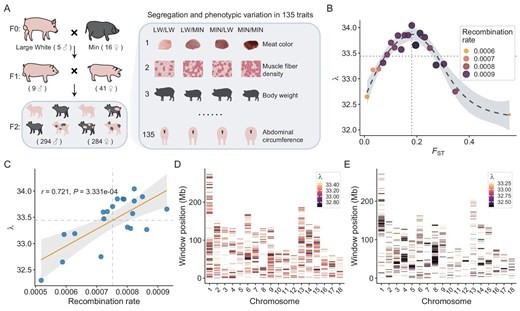
Figure. Hybrid effect variation in the LW-MIN F2 population mediated by genetic differentiation and recombination