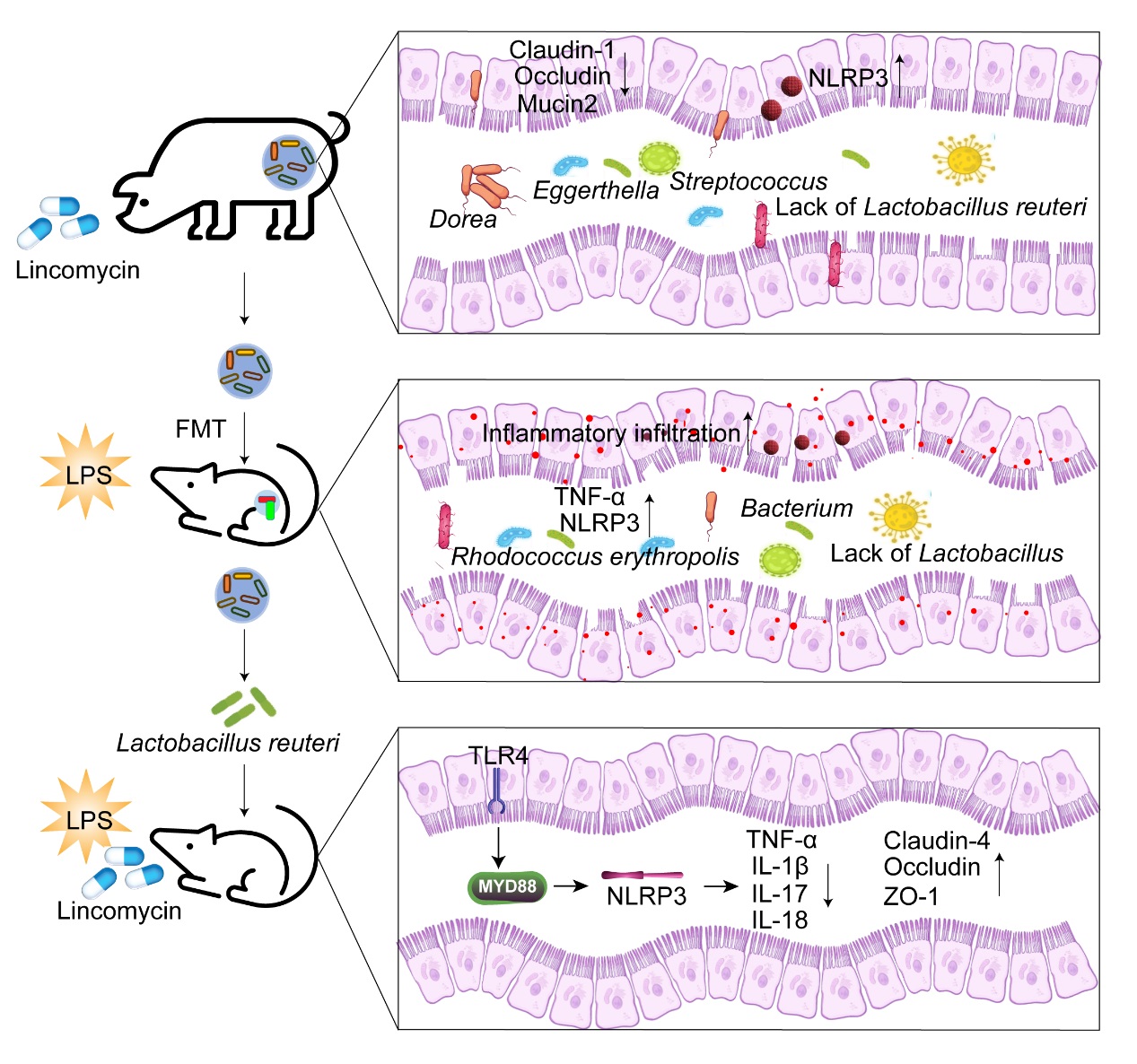


Recently, the Livestock Nutrition and Regulation Research Team at the Institute of Animal Science, Chinese Academy of Agricultural Sciences, revealed the mechanisms underlying how early-life exposure to lincomycin exacerbates the body's susceptibility to inflammation, and how supplementation with Lactobacillus reuteri strain SKLAN202402ZF effectively alleviate intestinal inflammation and barrier damage. The related research findings were published in the journal Microbiome.
Lincomycin is a common lincosamide antibiotic used in animal husbandry, often causing side effects including antibiotic-associated diarrhea and pseudomembranous colitis. During early life in animals, the gut microbiota and immune system are in a critical developmental window, making the negative impacts of lincomycin exposure particularly significant. Lactobacillus reuteri (L. reuteri) is widely present in the intestines of humans and animals and has been proven to have functions such as immune regulation, inflammation suppression, and enhancement of the intestinal barrier. This study focused on the effects of early-life lincomycin exposure on the gut microbiota and immune homeostasis, and explored the role of L. reuteri supplementation in alleviating antibiotic-associated intestinal damage, providing new insights for related prevention and treatment strategies.
Researchers transplanted fecal microbiota from control group or lincomycin-exposed group piglets into mice, respectively. When the mice were challenged with lipopolysaccharide (LPS), those receiving microbiota from lincomycin-exposed donors exhibited more severe inflammatory responses and more significant weight loss. The abundance of the Lactobacillus genus in their colons was reduced, indicating that antibiotic-induced dysbiosis makes the host more sensitive to subsequent inflammation. Subsequently, mice were first exposed to lincomycin, then supplemented with L. reuteri, and finally challenged with LPS. The results showed that mice supplemented with L. reuteri had significantly less intestinal barrier damage and inflammatory cell infiltration compared to the antibiotic-exposure-only group. Mechanistic analysis revealed that L. reuteri suppresses LPS-induced intestinal inflammation by inhibiting the activation of the TLR4/MyD88 pathway, thereby downregulating the activation of the NLRP3 inflammasome.
The aforementioned research indicates that supplementing the missing L. reuteri may repair the intestinal barrier and alleviate inflammation by multi-target regulation of the host's immune response. This study not only deepens our understanding of the mechanisms behind antibiotic side effects but also provides a potential probiotic intervention strategy for mitigating lincomycin-associated gastrointestinal injury.
This research was supported by projects from the National Natural Science Foundation of China, the Youth Innovation Program of the Chinese Academy of Agricultural Sciences, and the Agricultural Science and Technology Innovation Program.
https://doi.org/10.1186/s40168-025-02327-z