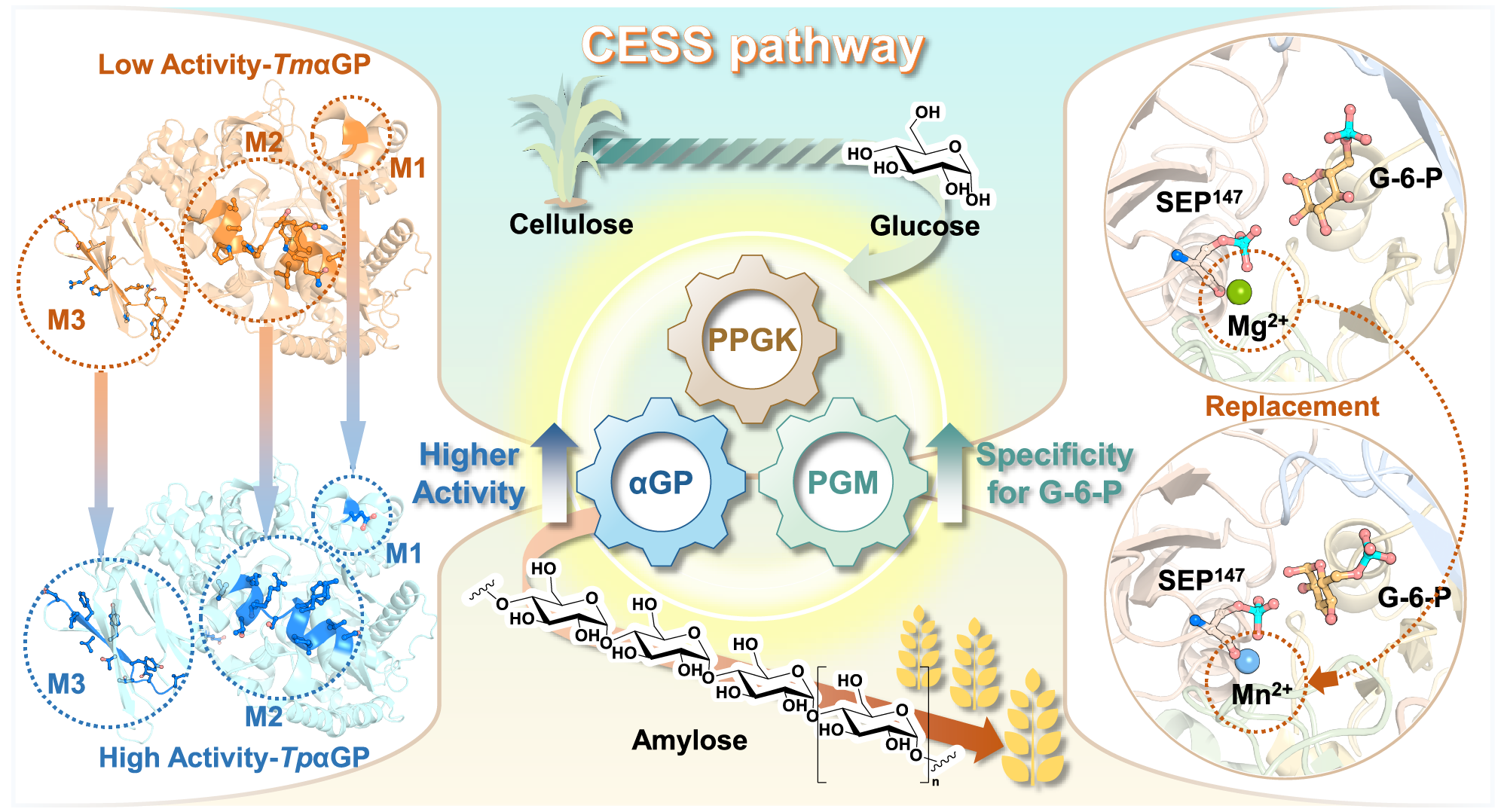


Recently, researchers at the Institute of Animal Science, Chinese Academy of Agricultural Sciences, developed a carbon-economical starch synthesis (CESS) pathway. The team established an ATP-free, photosynthesis- independent in vitro multi-enzyme cascade system that enables directional conversion of cellulose into starch, with relevant research published in the journal Engineering.
Starch serves as an indispensable raw material for food production and industrial manufacturing worldwide. Traditional agricultural starch production heavily relies on low-efficiency plant photosynthesis, arable farmland and favorable climatic conditions, leading to poor sustainability. Each year, approximately 180 million tons of cellulose are generated mainly from crop straw and residues, most of which are discarded via incineration or landfill, causing massive resource waste. Though enzymatic saccharification can break cellulose down into glucose effectively, further conversion of glucose to starch faces prominent bottlenecks: low catalytic activity and weak substrate specificity of key enzymes, alongside reversible core catalytic reactions. To tackle these drawbacks, the study optimized a cell-free triple-enzyme cascade termed the CESS pathway.
This in vitro system consists of three core biocatalysts: polyphosphate glucokinase (PPGK) for glucose activation without adenosine triphosphate consumption, phosphoglucomutase (PGM), and α-glucan phosphorylase (αGP). The researchers modified the rate-limiting αGP derived from Thermotoga petrophila to obtain mutant TpαGPM7, whose catalytic efficiency rose by 4.54 times. Cofactor screening further revealed that 20 mmol∙L⁻¹ Mn²⁺ dramatically shifts PGM catalytic bias toward starch synthesis. At 60 °C, the optimized cascade transforms 5.4 g∙L⁻¹ glucose (30 mmol∙L⁻¹) into 3.50 g∙L⁻¹ amylose starch. It attains an unprecedented conversion rate of 71.93% and a space-time yield of 2.33 g∙L⁻¹∙h⁻¹, with carbon loss controlled below 30%. All characterization tests confirm the synthesized product is pure amylose.
This photosynthesis-free biomanufacturing platform provides a sustainable strategy to upcycle agricultural cellulosic waste into edible starch. It not only safeguards global food supply stability but also fuels the development of circular bioeconomy. Shen Yiwen is the first author of this paper, while Research Fellows Tu Tao, Luo Huiying and Huang Huoqing act as corresponding authors. This research was jointly funded by the National Key Research and Development Program of China and the National Natural Science Foundation of China.