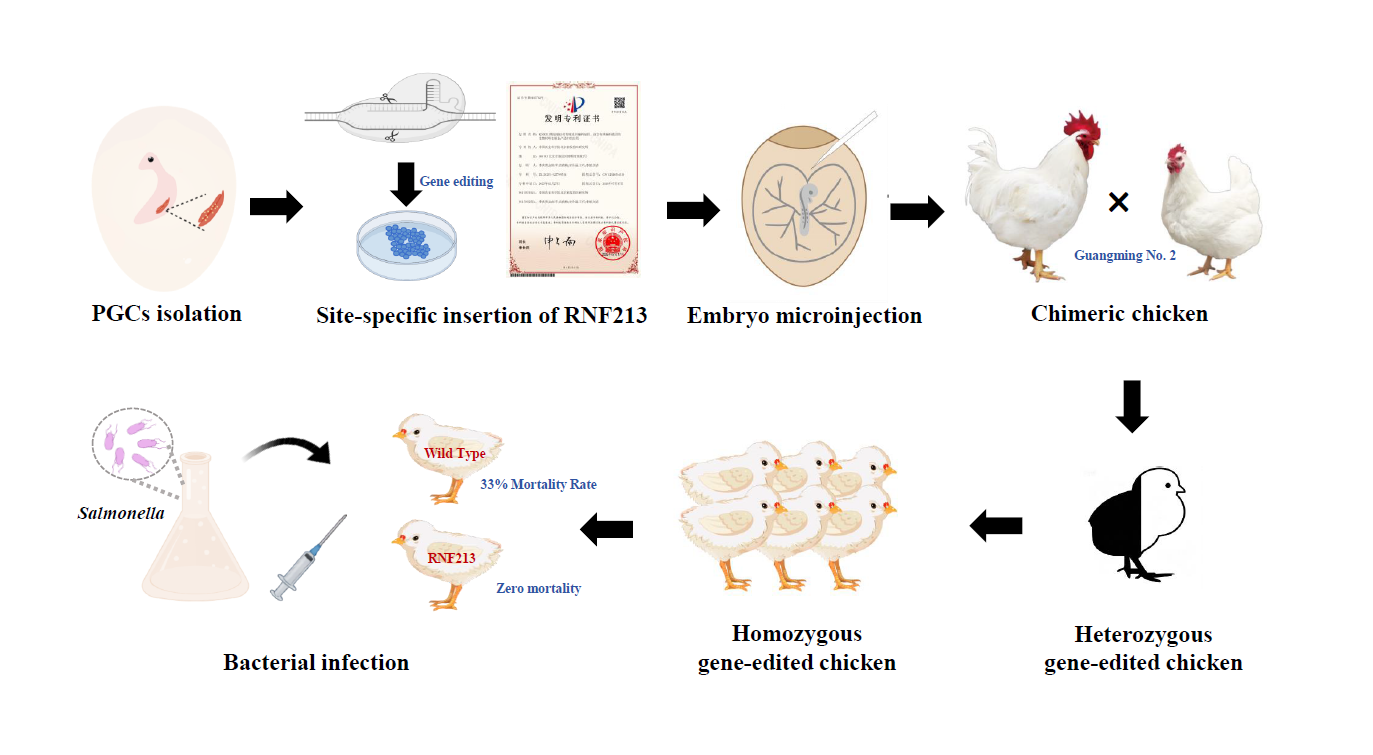


Recently, the Chicken Genetics and Breeding Research Team at the Institute of Animal Science, Chinese Academy of Agricultural Sciences (CAAS), in collaboration with Guangxi University, successfully bred the world's first gene-edited chickens resistant to Salmonella. This breakthrough overcomes the technical bottleneck of lacking effective targets for gene editing against Salmonella in livestock and poultry, and has pioneered the creation of a gene-edited chicken population with significant Salmonella resistance. This achievement marks China's entry into the world's leading ranks in the field of disease-resistant breeding in livestock and poultry.
Salmonella not only spreads horizontally and vertically among chicken flocks, severely threatening poultry production and germplasm security, but can also be transmitted to humans, posing a major public health and safety risk. The pathogenic mechanism of Salmonella is extremely complex, with a large number of virulence genes activated during infection. Due to the lack of clear, high-efficiency targets—analogous to viral receptors—for gene editing, there have been no international reports of gene-edited animals resistant to Salmonella.
Adopting a "capture the king first" strategy, the project team targeted lipopolysaccharide (LPS), one of the most important virulence factors of Salmonella. Leveraging the fact that the RNF213 promotes LPS ubiquitination, thereby inducing cells to effectively eliminate Salmonella, the team employed technologies such as gene editing in chicken primordial germ cells (PGCs) and sterile chicken "surrogate" hosts to precisely integrate the RNF213 gene into the genome. This enables high-efficiency expression and antibacterial action during bacterial infection. The core technology has been granted a National Invention Patent (Patent No.: ZL 2025 1 0227495.X). Using China's independently developed white-feathered broiler variety "Guangming No. 2" as the base material, the team successfully created the Salmonella-resistant gene-edited chicken population after three years of research. Multiple challenge tests with different types of Salmonella confirmed that the gene-edited chickens achieved "zero" mortality after infection, while their growth performance showed no difference from that of normal white-feathered broilers.
Professor Zhao Guiping, the project team leader and Chief Scientist of the National Broiler Industry Technology System, stated that the global annual cost for Salmonella eradication and control in breeding broilers amounts to hundreds of millions of dollars. Utilizing gene-editing technology to breed Salmonella-resistant chickens represents a major breakthrough in disease-resistant breeding and is of epoch-making significance for ensuring efficient broiler farming and the safety of poultry eggs and meat. The team will further conduct biosafety assessments of the gene-edited chickens and accelerate the application of the research outcomes to support the high-quality development of the broiler industry.
This research was supported by the Science and Technology Innovation 2030 – Major Project for Agricultural Biological Breeding, the CAAS Science and Technology Innovation Project, and other funding programs.