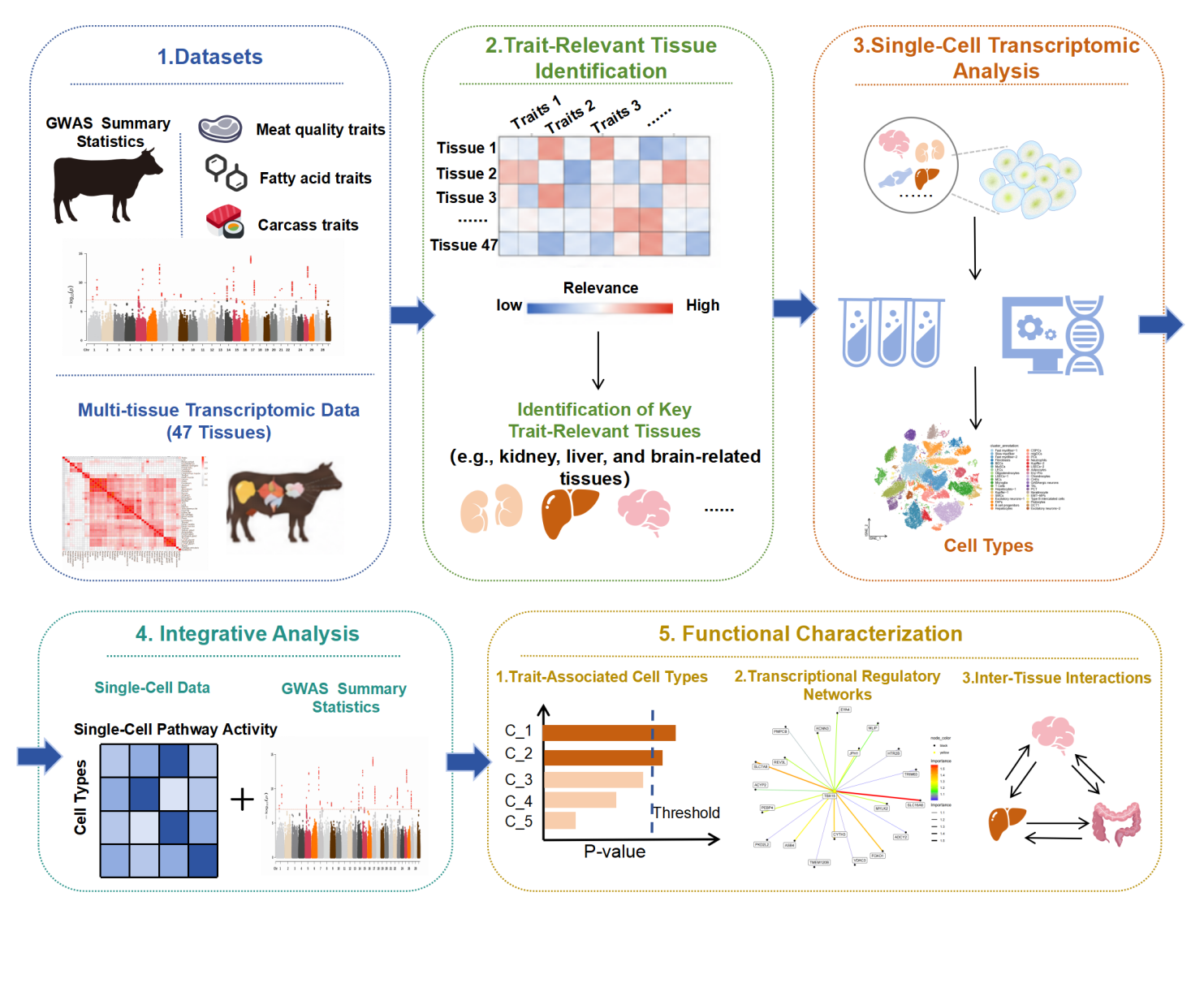


Recently, researchers from the Institute of Animal Sciences, Chinese Academy of Agricultural Sciences (IAS-CAAS), revealed the tissue- and cell-type-specific regulatory architecture underlying economically important traits in beef cattle by integrating genome-wide association studies (GWAS) with multi-tissue and single-cell transcriptomic data. The findings were published in the Journal of Animal Science and Biotechnology.
Carcass yield, meat quality, and fatty acid composition are major targets of beef cattle breeding. Although GWAS have identified numerous trait-associated variants, the tissues and cell types through which these genetic signals exert their effects remain largely unclear.
The researchers integrated GWAS data for 20 economically important traits in Huaxi and Chinese Simmental cattle with gene-expression profiles from 47 tissues. Eight trait-relevant tissues were further analyzed using single-cell or single-nucleus RNA sequencing, providing a framework for linking genetic associations to specific tissues, cell types, and regulatory networks.
At the tissue level, fatty acid-associated genetic signals, including those for palmitic acid (C16:0) and arachidonic acid (C20:4), were enriched in the liver. Carcass traits were associated with longissimus dorsi muscle and renal tissues, whereas meat-quality traits showed associations with cartilage and bone marrow, highlighting both tissue-specific and multi-tissue regulation. At the cellular level, 72,736 high-quality cells and nuclei were classified into 38 cell types. Myofibers were strongly associated with multiple carcass and meat-quality traits, while hepatocytes were closely associated with fatty acid and meat-quality traits. Fibro/adipogenic progenitors and chondrocytes were also associated with marbling score. Further analyses identified key cell-type-specific regulators, including TBX15 and SOX6 in myofibers, FOXA2 and NR1H4 in hepatocytes, and IRF8 and IKZF1 in microglia.
Notably, hepatocytes and microglia showed distinct associations with saturated and unsaturated fatty acid traits, respectively, and both were enriched for a candidate liver–brain axis gene signature, suggesting potential cross-tissue coordination between hepatic lipid metabolism and central neuroimmune regulation.
Overall, the study provides a cell-resolved framework for understanding the genetic regulation of economically important traits in beef cattle and offers new insights for functional gene discovery, mechanistic studies, and precision breeding.
The work was supported by the STI2030-Major Projects, the National Key R&D Program of China, the Agricultural Science and Technology Innovation Program of the Chinese Academy of Agricultural Sciences, and the Program of National Beef Cattle and Yak Industrial Technology System, China.
Article Link:
https://doi.org/10.1186/s40104-026-01471-2