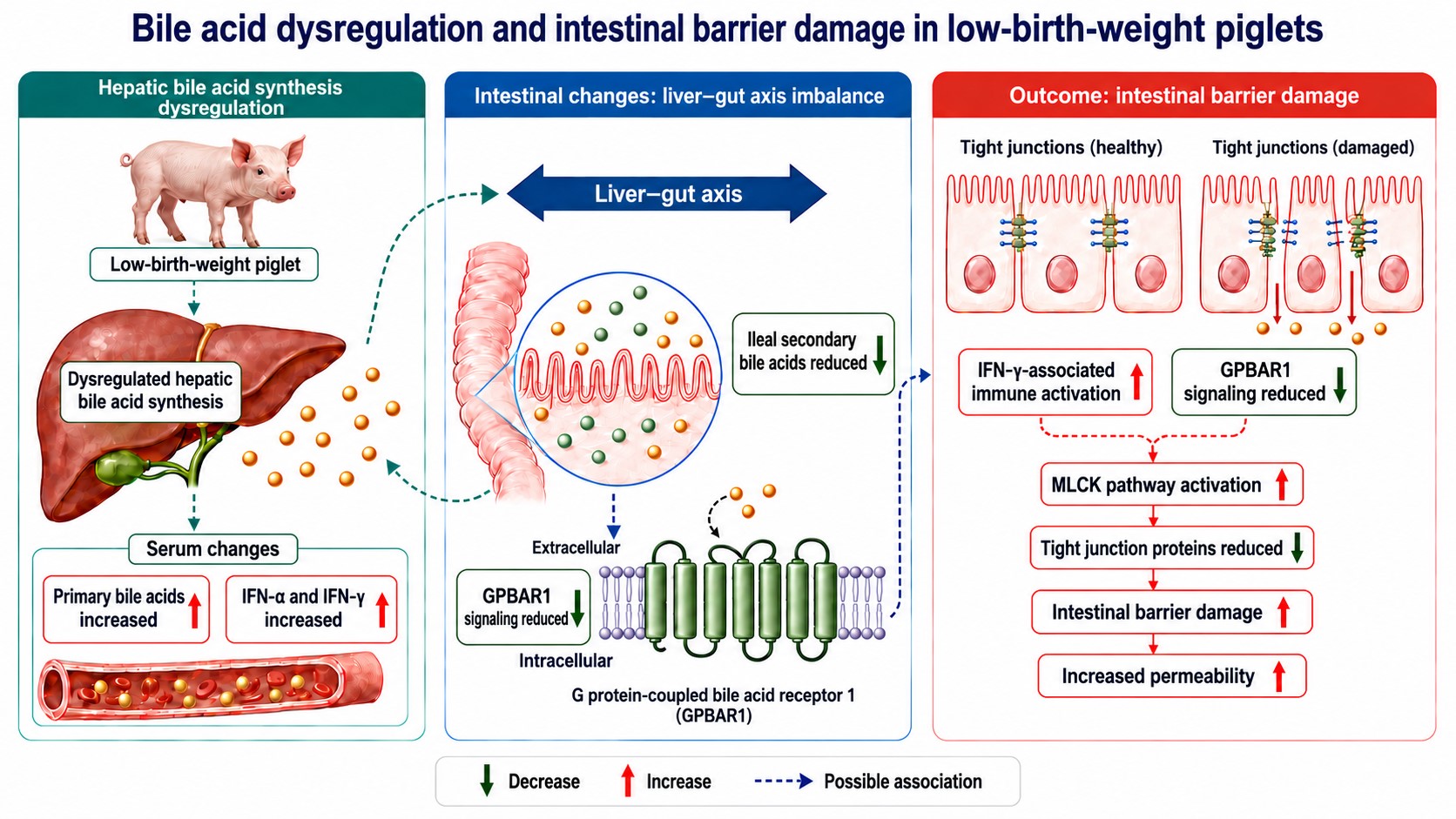


The Livestock Nutrition and Regulation Research Team at the Institute of Animal Science, Chinese Academy of Agricultural Sciences (CAAS), has identified a link between dysregulated bile acid metabolism and impaired intestinal barrier function in low-birth-weight suckling piglets. Published in Animal Nutrition, the study highlights a potential role for G protein-coupled bile acid receptor 1 (GPBAR1) signaling in maintaining intestinal epithelial integrity, offering insights into the mechanisms underlying intestinal dysfunction in these vulnerable animals.
Low birth weight is common in pig production and is associated with restricted neonatal growth, increased susceptibility to inflammation, and impaired intestinal barrier function. In addition to facilitating lipid digestion and absorption, bile acids serve as signaling molecules linking the liver, gut microbiota, and host immunity. Secondary bile acids produced by gut microbes can act through GPBAR1 to regulate inflammatory responses and epithelial homeostasis. How disruptions in bile acid metabolism relate to intestinal barrier damage in low-birth-weight piglets, however, remains poorly understood.
Researchers compared paired low- and normal-birth-weight suckling piglets. They combined targeted bile acid profiling, transcriptome and 16S rRNA gene sequencing, histological and ultrastructural assessments, and molecular analyses to investigate bile acid metabolism along the liver–gut axis and its relationship with intestinal barrier function.
The study found that low-birth-weight piglets exhibited dysregulated hepatic bile acid synthesis, reduced intestinal GPBAR1 signaling, and damage to the intestinal epithelial barrier. Further experiments in cultured intestinal epithelial cells showed that pharmacological inhibition of GPBAR1 increased susceptibility to interferon-γ (IFN-γ)-induced injury. These findings suggest that GPBAR1 signaling may contribute to intestinal barrier homeostasis and help explain the association between bile acid dysregulation and epithelial injury in low-birth-weight piglets. They also provide a basis for further research into early nutritional interventions to support intestinal health.
Chang Yin and Ye Xu, doctoral students at the institute, are co-first authors of the paper. The co-corresponding authors are Prof. Zhang Hongfu and Prof. Chen Liang. This research was supported by the National Natural Science Foundation of China, the Fundamental Research Funds for Central Public-interest Scientific Institutions, and the Agricultural Science and Technology Innovation Program of CAAS.
Article link: https://doi.org/10.1016/j.aninu.2026.01.020