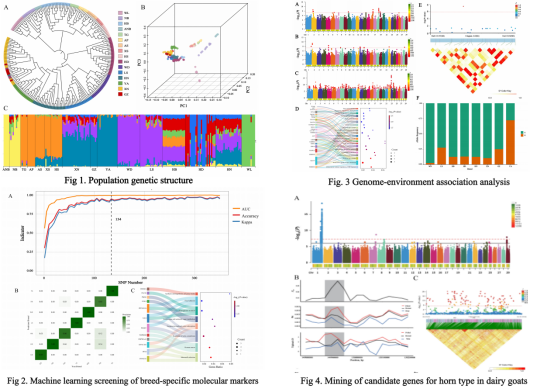


Recently, the Sheep Genetics and Breeding Research Group characterized the genetic structure of Chinese dairy goats, developed a panel of SNP markers for accurate breed identification, and identified genes and key genetic variants associated with environmental adaptation, horn morphology, and coat color. The findings were published in the Journal of Animal Science and Biotechnology.
Dairy goats provide humans with milk, meat, wool, leather, and other livestock products, playing an important role in animal husbandry. China possesses abundant dairy goat genetic resources that have developed distinctive genetic characteristics under long-term natural selection and artificial breeding. In this study, the research team performed whole-genome resequencing of eight Chinese dairy goat breeds together with representative goat populations from other countries to systematically investigate the population genetic structure of Chinese dairy goats.
The results revealed pronounced genetic differentiation between Chinese dairy goats and introduced breeds, as well as clear genetic substructure corresponding to their geographic origins. Multiple gene flow events among dairy goat populations were also detected. In addition, the researchers developed a molecular marker panel consisting of 134 SNPs, which achieved a classification accuracy of 95.1% for Chinese dairy goats. This marker panel provides a valuable resource for establishing a low-cost and highly efficient molecular identification system for dairy goat breeds. Landscape genomic analyses identified genes associated with environmental adaptation, including HDAC10 with a missense mutation at chr5:118557145 A>G (Q123R). By integrating selection-signature analyses with genome-wide association studies (GWAS), the study further elucidated the genetic basis of horn morphology, involving genes such as RXFP2 and ERG, and coat color, involving genes such as ASIP and MITF. Several potentially important missense variants were also identified, including ERG (R349P) and MITF (I13V).
These findings provide a genomic foundation for the accurate identification, conservation, and genetic improvement of dairy goat germplasm resources. Jinke Xiong is the first author of this paper, and Professor Li Zhang is the corresponding author. This work was supported by the Agricultural Science and Technology Innovation Program of the Chinese Academy of Agricultural Sciences, the Fundamental Research Funds for Central Public-interest Scientific Institutions, and relevant research programs of the Inner Mongolia Autonomous Region implemented through an open competition mechanism.
https://doi.org/10.1186/s40104-026-01473-0