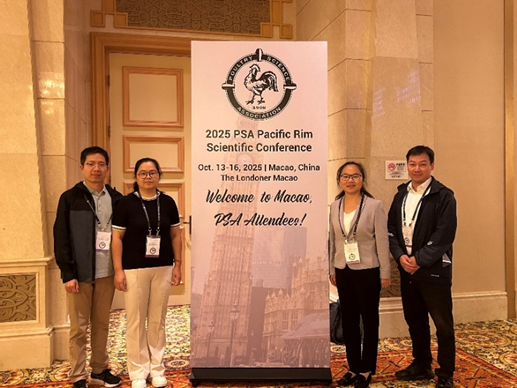


The 2025 PSA Pacific Rim Scientific Conference was held from October 13 to 16 in Macau, marking the Poultry Science Association's (PSA) first regional scientific meeting in the Pacific Rim. The conference brought together over 260 poultry scientists, educators, students, and industry professionals from Asia, Oceania, and the Americas. Featuring seven symposia and the presentation of over 200 scientific papers through oral and poster sessions, the event focused on core topics including poultry genetics, nutrition, health, environment management, and sustainable development.
Four researchers from the Institute of Animal Science, Chinese Academy of Agricultural Sciences (IAS-CAAS) attended the conference. They presented their latest findings in a series of oral presentations:
Professor Yanyan Sun and Assistant professor Yunlei Li from the Laying Hens and Pigeons Genetics and Breeding Research Team presented on "Microscopic morphology and single-cell level evaluation of day-old chick ovary vitrification and orthotopic transplantation for breed restoration" and "Multi-omics reveals key cell types and gene families regulating eggshell strength in chicken uteri". Associate professor Jingjing Xie from Chicken Nutritional Metabolism and Regulation Research Team delivered a talk entitled "Effects of exogenous protease on postabsorptive energy metabolism of broiler chickens". Associate professor Jing Tang from Waterfowl Breeding and Nutrition Research Team shared research on "Effects of cholecalciferol and 25-hydroxycholecalciferol on reproductive performance, egg quality and plasma biochemical indices of aged duck breeders".
The IAS-CAAS delegation also engaged in extensive academic discussions and exchanges with expert peers and PSA members from several renowned international institutions, including Purdue University, the University of Alberta, the University of Kentucky, the University of Georgia, and the University of Sydney.
This participation not only successfully showcased the Institute's latest research advances in areas such as poultry germplasm resource preservation, elucidation of mechanisms regulating important traits, and nutritional regulation but also significantly enhanced the researchers' ability to grasp international research frontiers and strengthen their global scientific collaboration networks.